
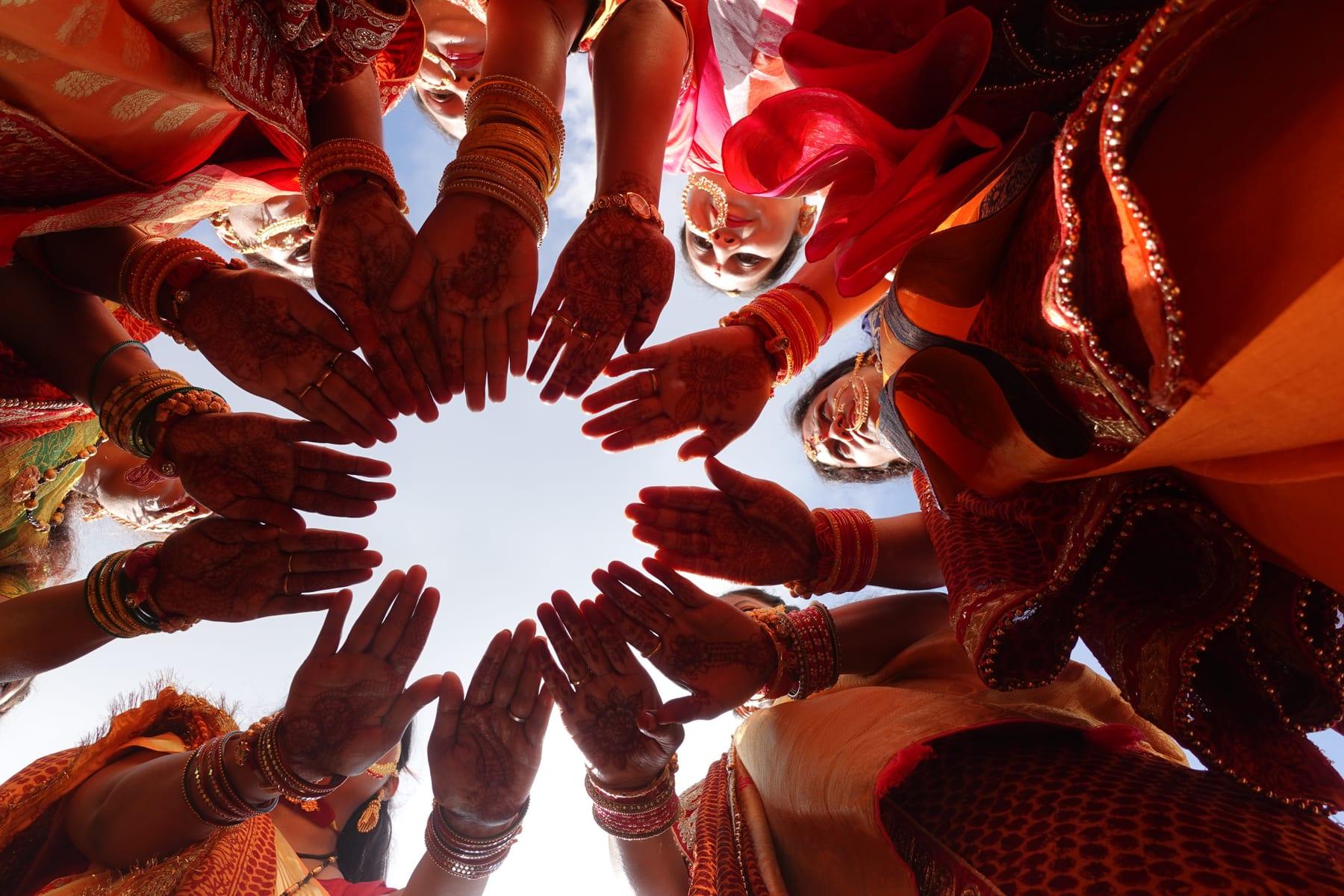
A daughter of this house, Uma, married Akshit of the Bhandari family — kept the old way, at home, rite by rite. This is the wedding most fully documented here: every photograph and film on these pages is theirs.
In November 2021, Uma — a daughter of this house — was married to Akshit of the Bhandari family, here at home in Kunja. By the calendar it was a single day; by its keeping, it was the fullest kind, every rite given its whole weight, from the turmeric of the morning to the seven steps around the fire in the small hours.
Because it was held in the village, the whole village had a hand in it — the road cleared and the courtyard readied, the suwal fried in great batches, the women gathered evening after evening to sing the mangal geet. Everything you read on the canonical pages — every rite, every photograph — is drawn from these days.
It is the wedding this whole section is built on: the one we documented most closely, rite by rite, so that the way a Pahadi wedding is kept would not be lost.
The wedding, on film
Watch the day unfold
The whole wedding, kept the old way — turmeric to the seven steps — gathered into one film.
Whose wedding this is
Two families, joined
The bride
Uma
Daughter of this house · Kunja
Married from the home she grew up in, in the village of Kunja near Jageshwar.
The groom
Akshit
Bhandari family · Bhandari Gaon, Bageshwar
Of the Bhandari family, from Bhandari Gaon in the Bageshwar hills.
How long
1 day · Traditional
Where it was held
Kunja · House
The family married into
Bhandari
Native of
Bhandari Gaon · Bageshwar
The day, in order
How the wedding unfolded
Rite by rite, as it happened over these days — each with the couple's own photographs. Tap any rite to read what it means on the canonical pages.
Pithyaan — the mark, and the teek
Pithya · Teek · पिठ्याँ · टीकNothing here begins without pithya — the Kumaoni mark of rice and turmeric pressed onto the brow. In its first form it is the teek: the groom's elders carry it to the bride's home to seal the match — the engagement, made the old way. From then it opens every rite that follows, given again and again; the one humble thread that ties all the days together.
What this rite meansSuwal Pathai — frying for the gods
Suwal Pathai · सुवाल पथाईDays ahead, the women gather to fry the suwal — the sacred breads offered first to the gods and the ancestors. They knead and fry and sing as they work, an old song calling the forebears down to bless the union before a single guest has arrived.
What this rite meansHaldi — the turmeric morning
Haldi · हल्दीTurmeric, laughter and colour — the morning the bride and groom are made to glow. Relatives smear the bright paste over face, arms and feet, for a shine and for protection; and from this hour the bride's parents fast, and won't eat again until she has left.
What this rite meansMehndi — the henna night
Mehndi · मेहंदीAn evening of henna, song and the slow patterning of the bride's hands. The women gather close as the cones trace fine dark vines across her skin, the groom's name hidden somewhere in the design — the last unhurried night before the wedding day breaks.
What this rite meansMahila Sangeet — the women's night
Mahila Sangeet · महिला संगीतThe women's night, given over wholly to music. Mangal geet and shakun-aakhar — the old auspicious songs of Shiva and Parvati's own wedding — rise in call and answer, led by the gidaar and carried late, and tender, into the cold hill night.
What this rite meansBaraat — the procession
Baraat · बारातThe groom comes for the bride with his procession — a brass band ahead, and the Chholia whirling with sword and shield. From a gathering spot nearby the bride's youngest brother is borne in on the doli, the groom following on a horse, and the two sides at last meet.
What this rite meansDhuli Argh — the welcome at the door
Dhuli Argh · धूलि अर्घ्यAt dusk, the bride's family welcomes the dust-covered procession at the door. Unmarried girls come out bearing water urns and lamps, a design is laid in clay and rice-flour, and the groom — honoured as a form of Vishnu — has his feet washed before he is led inside.
What this rite meansVarmala — the garlands
Varmala · वरमालाThe garlands — the first thing they do as a couple, in front of everyone. Lifted onto their families' shoulders amid much teasing, each tries to garland the other first; and in that bright, laughing moment, the two families quietly become one.
What this rite meansKanyadaan — the giving away
Kanyadaan · कन्यादानThe hardest rite of them all — a father gives his daughter away. He places her hand into the groom's and, as the family pours water over their joined hands, lets her go; then the groom fills the parting of her hair with sindoor, and it is done.
What this rite meansSaat Phere — the seven steps
Saptapadi · सात फेरेSeven steps around the sacred fire, seven vows — and they are married. Hands knotted by the aanchal, the couple circles the flame as the bride's brother feeds puffed rice into it; seven lamps are lit, the seventh worshipped, and nothing is ever the same.
What this rite meansBidaai — the farewell
Bidaai · बिदाईThe goodbye, and the tears — the bride leaves the home she grew up in. She is carried in the doli to the departure point nearby, throwing a handful of rice back over her shoulder; a last blessing left for the house, and the truest, hardest moment of all the days.
What this rite meansWho saw her off
The ones who walked her the whole way
Sasural — the new home
Sasural · ससुरालShe crosses a new threshold — escorted the whole way there by her own brothers — and is welcomed into the family that is hers now too. A reception waits on the groom's side, and a day or two of their own rites, before the new life begins to settle.
What this rite meansA fasak — talk around the rite
Fasak फसकa chat, a natterWhy the brothers — and never a sister?
When she leaves, it's her brothers who walk her all the way to the groom's house. Why never a sister?
So that someone of her own stays beside her the whole way, right up to the new door. In the old days that simply fell to the men — they were the ones who went out, while the women kept the home running.
But that's only how it was. Why couldn't it be a sister, or any woman she loves, by her side instead?
You're right — there's no real reason it can't. I think we'll see it become a mix, in time. Perhaps it already is, quietly, in homes like ours.
Katha — the homecoming blessing
Katha · कथाOnce the couple is home, the family holds a katha — a day of recitation and puja to bless the new marriage. It is kept at home or at a temple; in our family's case, high on the ridge at the Vriddha Jageshwar shrine, which made it ours twice over.
What this rite meansIsht Devta's blessing — the temple visit
Isht Devta · इष्ट देवताThe couple's first act together — to seek their family deity's blessing. Every house has its own Isht Devta and its own shrine, in whatever form it comes; for us, that is Jageshwar Dham, the great Shiva temple of these hills.
What this rite meansThe cast of the day
Who was there
A wedding here is made by a whole village — the people who came to grace it, and the hands that made it happen. Each is carried on their own INUK card: the same trusted self, wherever they show up.
The hands behind it, and where it was bought
Pahadi Rasoi
The feast — catering
Almora
Himalayan Tents
Tent, light & sound
Barechhina
Chholiya dal
The sword-dance at the baraat
Lamgara
Bhandari Sweets
The mithai & the bal-mithai
Barechhina
Almora Sarafa
The nath & the gold
Almora
Rangwali Pichhora House
The bride's pichhora
Almora
The people who graced it
312 were there· showing 10
Diwan Singh Negi
The bride's father
Kamla Devi
The bride's grandmother
Pressed the first pithya onto every child of this house.
Harish & Bhagwati
The bride's mama & mami
Pushkar Das
Dhol-damau, all night
Hira Devi
Led the suwal-making
Gopal Ram
Cleared the road up
Narayan Singh
The eldest there
Knew every shakun-aankhar in the valley by heart.
Pooja & Naveen
Came from Almora
Deepa Bisht
Came from Bageshwar
Mahesh Joshi
Came from Haldwani
…and 302 more were there — each a name we can add, and a card away on INUK.
Photography
Whose eye this is
Most of the photographs and films on this page are Balaji's — two decades of Kumaoni weddings in their eye. A few of them, though, are our own.