
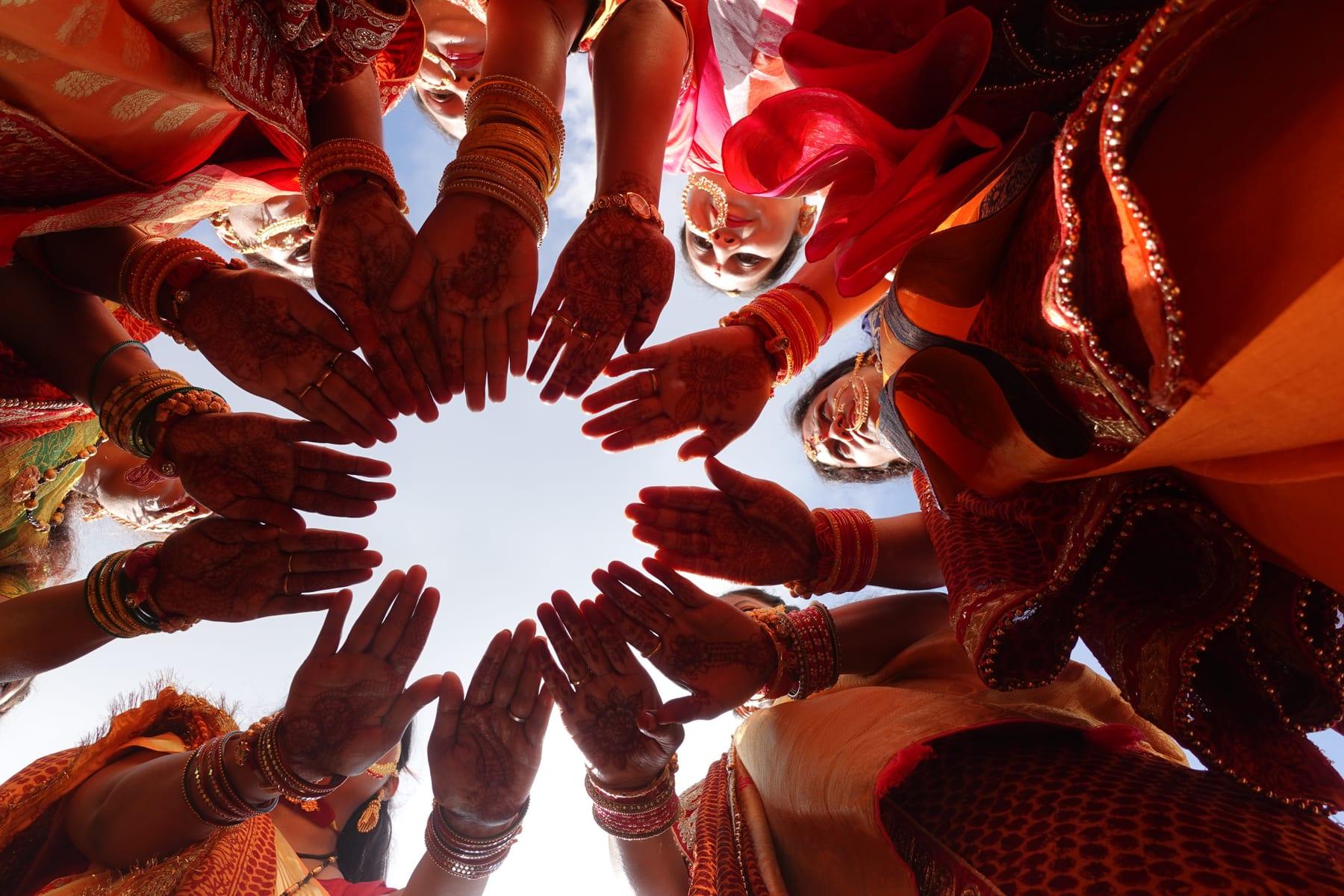
When two villages become one
A Pahadi Wedding
A Pahadi wedding, rite by rite — turmeric to the long goodbye.
All of ExploreThe rites, in order
Two families, one fire, and a whole village to witness it
Out here a wedding belongs to everyone. Courtyards are scrubbed and painted, ancestors are sung for, firewood is cut by the cartload, and a hundred small rites carry the couple from the first auspicious mark to the seventh step around the flame.
Many are shared across Hindu India; a handful — pithya, suwal pathai, dhuli argh, the Chholia sword-dance — belong only to Kumaon. Walk through them here in the order they actually happen, the way a guest of the house would live them.
How long it lasts
One day, or two?
How long a wedding runs is its own quiet question — and the answer has been changing with the times.
Do Dini · दो दिनी
The two-day way
The old way, set by the stars: the marriage muhurat falls in the small hours — ours was near one or two in the morning. The baraat reaches the bride's home by evening, stays the night through the rites, and leaves only the next morning.
Ek Dini · एक दिनी
The one-day way
The newer way, set by the clock: the baraat leaves in the morning, the rituals and the feasting are folded into a single day, and by evening it is all done and the couple already on their way.
Four ways to marry
Where a hill wedding happens
Where and how a wedding is held is its own quiet choice — and it says a great deal about a family. There are four ways, broadly; this house has always kept to the first.
At home, the old way
Held in the house and the village, every ritual kept the way it always has been — the fullest and the hardest of all the ways, and the one this family has always chosen. Nearly everything on these pages is it.
In a hall or hotel
The popular way now: a wedding hall or a convention centre, quicker and a good deal louder, the same rites run but run lighter. Far easier for a family that lives away from the hills, where home is a long road back.
Quietly, at a temple
The simplest of all — the couple to a temple with a small gathering, a few words said before the god, and it is done. The fewest rites, the least fuss, the soonest over; and for some, exactly right.
Plainly, by the court
The plainest path of any: a registrar, two signatures and the witnesses the law asks for. No rites are kept and no gods called — just the marriage made legal, sometimes done alongside the rest, and sometimes instead of it.
It takes a village
How a hillside readies for a wedding
Out here the big days don't belong to one family — they're arranged by everyone. Long before a single guest arrives, the village quietly takes the work on between them, each helping in whatever small way they can.
Clearing the way
The mud road, the footpaths and the trails up belong to no one and everyone. So before the day the village goes out together — to fill and fix what the rains have broken, and to cut back the grass and scrub that have closed the ways in.
Securing the water
Water is scarce up here, so the source and its long pipeline are cleared and checked in good time, well before the guests arrive. It is the one thing a wedding feeding hundreds can never be allowed to run short of.
Cutting the firewood
Cooking for hundreds over open fire needs a mountain of wood. So neighbours arrive with their own axes and saws to fell, split and stack the great store the kitchen will burn through — and the fires never once run cold.
Carrying the supplies
Few homes here sit by the road, so the groceries and the grain and all the rest are carried up the last stretch on foot and stored between many hands — load after load, exactly as they always have been.
Painting the house
The home is scrubbed, mended and freshly painted for the day it will host, and the village lends its hands to that too — each neighbour giving whatever small bit of the work they can, however busy their own day.
Raising the kitchen
A nearby field is roofed with tents and given over wholly to the cooking. It is kept under cover on purpose — so that a blessing falling from above reaches the couple and their family, and never the simmering pots.
And through all of it
All of it, community-driven
Not a rite is outsourced. The whole wedding runs on hands that turn up for free — for love, and for the plain joy of being part of someone's big day.
Everyone looks after everyone
Whoever has the least to do looks after whoever has the most. Up here, a celebration is really just how people remember to take care of one another.
None of it is hired or arranged. It's simply how the hills hold a celebration — and it's what makes a wedding here truly special.
What a wedding does to this house
The house lights up for every one of them
Any wedding lifts this house — in how it looks, and in something harder to name: the motivation, the energy, the pull of a gathering you can feel before you've even crossed the courtyard. Not everything always goes to plan; there are the ordinary frictions every house knows. But these are the memories this house is held together by — and goes on by, wedding after wedding, on and on.
The rites, in the order they happen
A wedding here is not one event but many, each making way for the next. Follow the flow — every rite opens to its own page, with its story and its photographs.
Before it's even fixed
The long road to a wedding — the matching, the meeting, the asking and the fixing — before a single date is set.
Before the wedding
The long build-up — the household, the village and the gods all made ready.
The wedding day
From the groom's arrival at dusk to the seven steps around the fire.
After the wedding
The leaving, the arriving, the gentle return home, and the blessings that follow.
A new livelihood
And lately, a trade grows around the day
Where once there were only neighbours lending a hand, a few skilled services are now taking root around the big days. With them comes honest work — and a handful of reasons for people to build a life up here, rather than leave the hills for the plains.
The catering
Cooks and crews who can feed three hundred from a single field kitchen, hired by the day — a craft that's become a real living for many a hill family.
Sound & tent
The lights, the music and the great cloth pavilions that turn a bare courtyard into a stage — raised and struck by local hands, season after season.
Photo & film
The ones who keep the day forever: hill photographers and filmmakers whose lens has quietly grown into a trade, and a reason to stay close to home.