
2026
How to see more birds: a field guide for beginners
You don't need expensive gear or years of practice — just a few simple habits. Here's how to turn an ordinary morning walk into one full of birds.
Back to the journal
Contents
- 01Go out at first light
- 02Listen as much as you look
- 03Move slowly, stop often
- 04Watch the edges
- 05Read the bird, not just the colour
- 06Dress quiet, move quiet
- 07A little kit goes a long way
- 08Start with the birds at your feet
- 09Learn the seasons
- 10A morning, start to finish
- 11Alone, or in good company
- 12What it gives back
You don't need much to start watching birds — not expensive optics, not years of practice, not even a field guide. What you need is to be a little earlier, a little quieter, and a little more patient. The birds are already here; the whole craft is simply about meeting them on their terms instead of yours.
Everything below is what we'd tell a guest who steps onto the terrace at Kunja for the first time, a mug of tea in hand, and asks how to actually see the birds they can hear. None of it is complicated. Put even half of it into practice, and an ordinary morning walk turns into one full of birds.
Go out at first light
The single biggest thing that separates a morning full of birds from an empty walk isn't your binoculars or your knowledge — it's the hour you set out. Birds keep banker's hours of their own. Through the cold Himalayan night they burn precious energy simply staying warm, and the moment the light comes up they have to feed, hard and fast, to make it back. That first hour after sunrise is when they are hungriest, boldest, most active — and most willing to be seen.
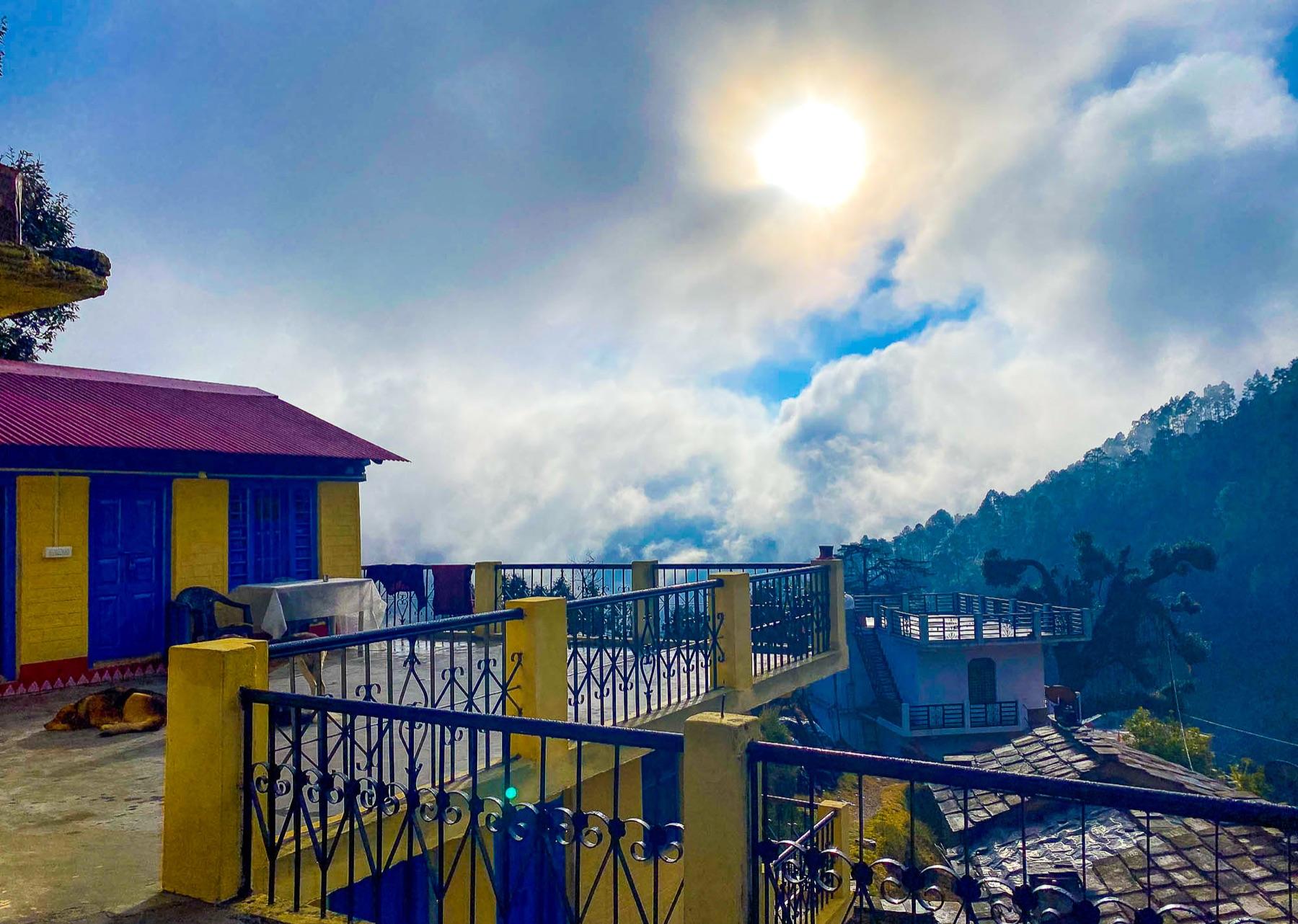
There is a second, quieter window at the other end of the day, in the last hour before dusk, when the birds feed up again before they roost. The long, flat middle of the day, by contrast, is the dead time: the sun is high, the heat builds, and most birds fall silent and tuck themselves into the shade. If you have only twenty minutes to give to birds, give them at dawn — you will see more in those twenty minutes than in a whole afternoon of trying. At Kunja you barely have to go anywhere for it: the terrace, with the oaks rising behind and the fields falling away in front, is the best seat in the house, and the kettle is never far.
Listen as much as you look
Beginners look; birders listen. Most birds announce themselves with their voices long before they ever show their bodies, and learning to hear them is the fastest way to start seeing more. You don't need to know them all — just a handful of the loudest, most common voices — and the dawn chorus stops being a wall of noise and becomes a roll-call of birds you can name.
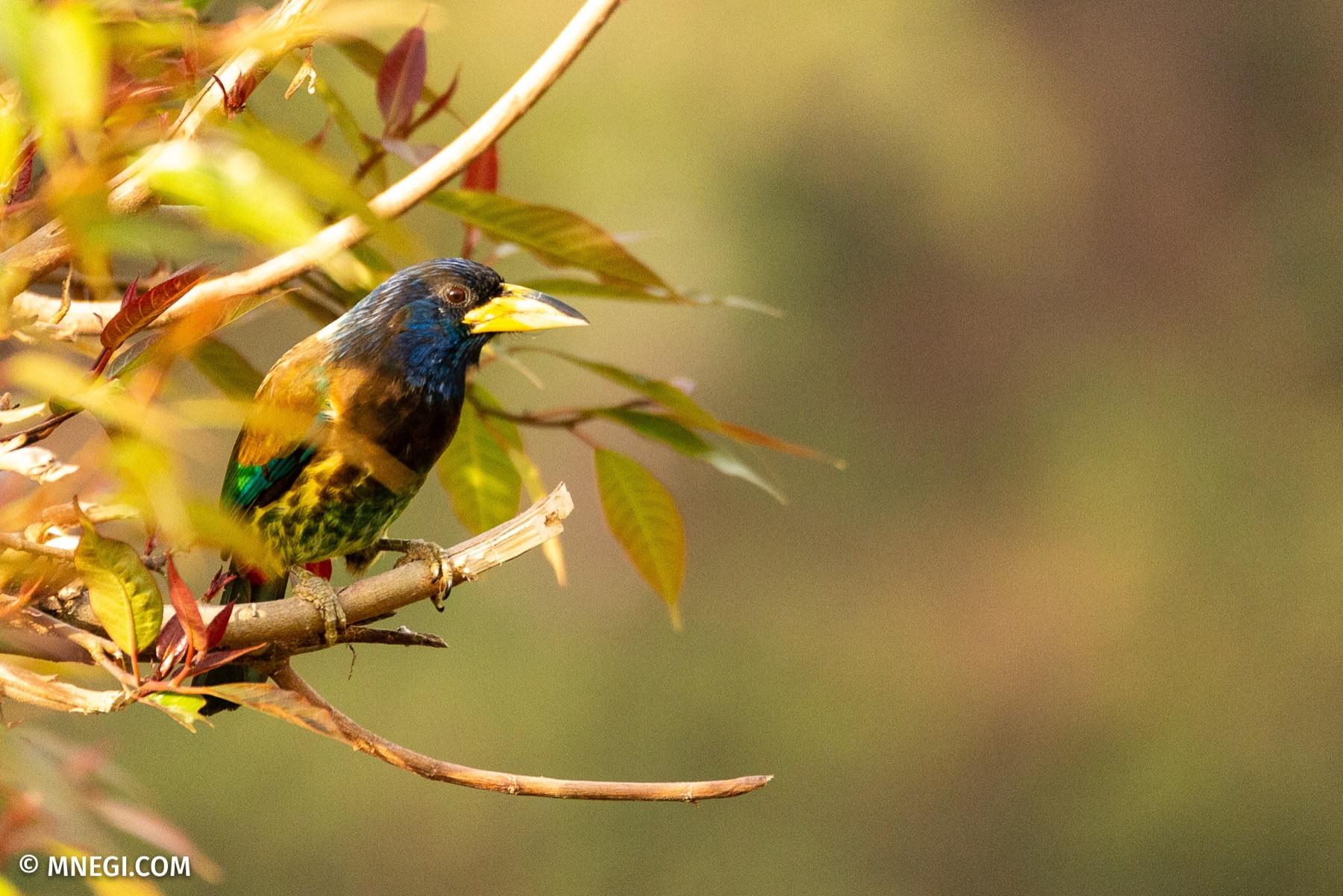
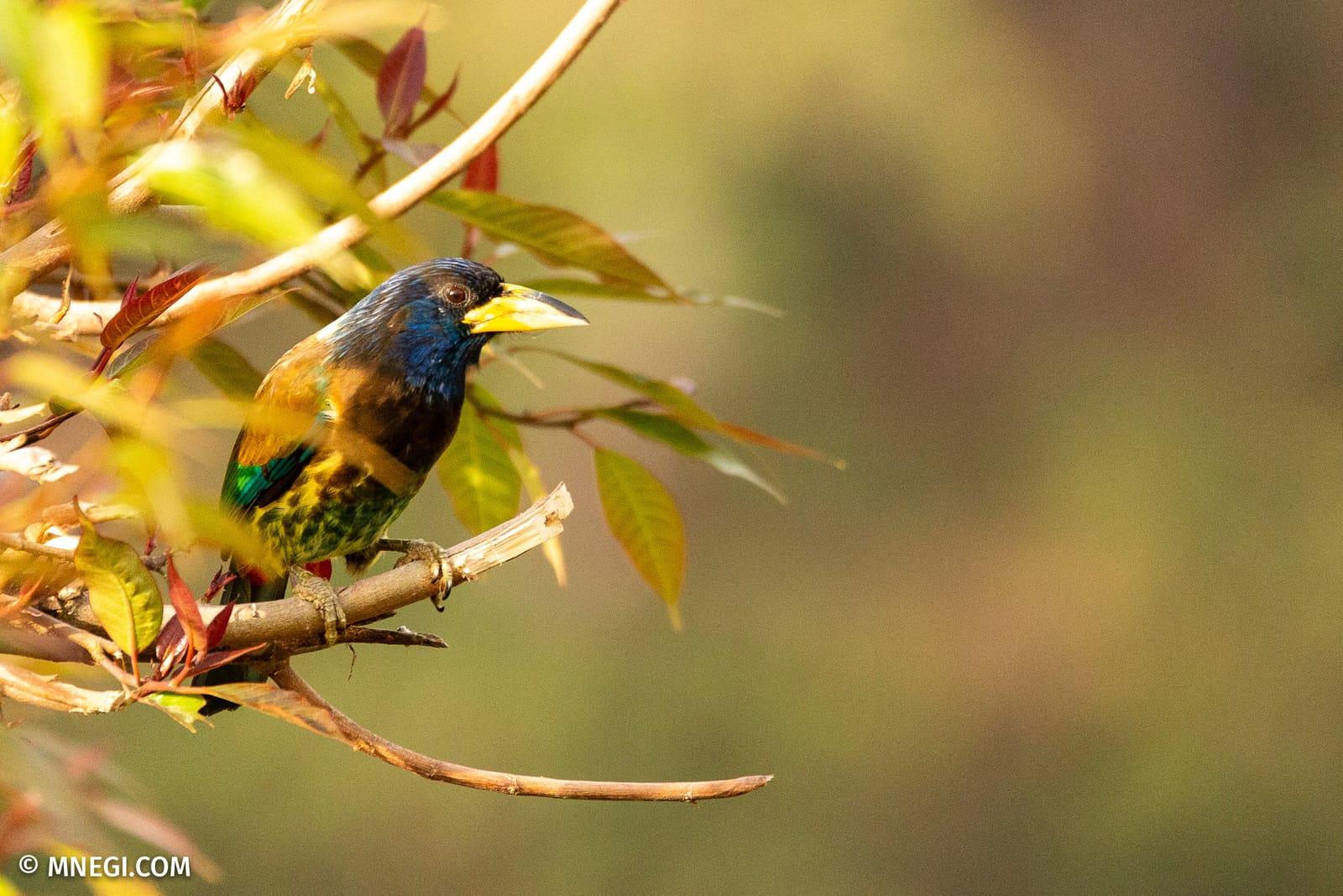
Start with three. The great barbet's far-carrying, monotonous note that rings out across the whole valley; the red-vented bulbul's cheerful, chattering babble from the hedges; and the thin, metallic call of a minivet passing high through the oaks. Once those three are lodged in your ear, you'll find your head turning to birds you would have walked straight past — and, more often than not, your eyes will follow the sound straight to the bird. A week of listening like this does more than a year of staring at pictures.
Move slowly, stop often
The most common mistake a new birder makes is to keep walking. A bird sees your movement long before you see the bird, and a person striding down a path is, to a bird, simply a large thing to be avoided. The fix is almost absurdly simple: take a few slow steps, then stop, and stand completely still.
Give it a minute or two. At first the place seems empty — and then, as the birds decide you are no longer a threat, it begins to fill back in around you. A flycatcher drops onto a wire. A warbler works its way along a branch. A tree that looked bare a moment ago turns out to hold half a dozen small birds, busy in the leaves. The stillness is the whole trick: the birds don't come because you found them, but because you stopped frightening them away.
Watch the edges
Birds, like most wild things, love an edge. The richest birding is almost always where one habitat meets another — where the forest meets the open field, where a stream runs along its bank, where the oak canopy breaks open to the sky. These seams are where food, cover, and open perches all sit close together, and birds gather there accordingly.
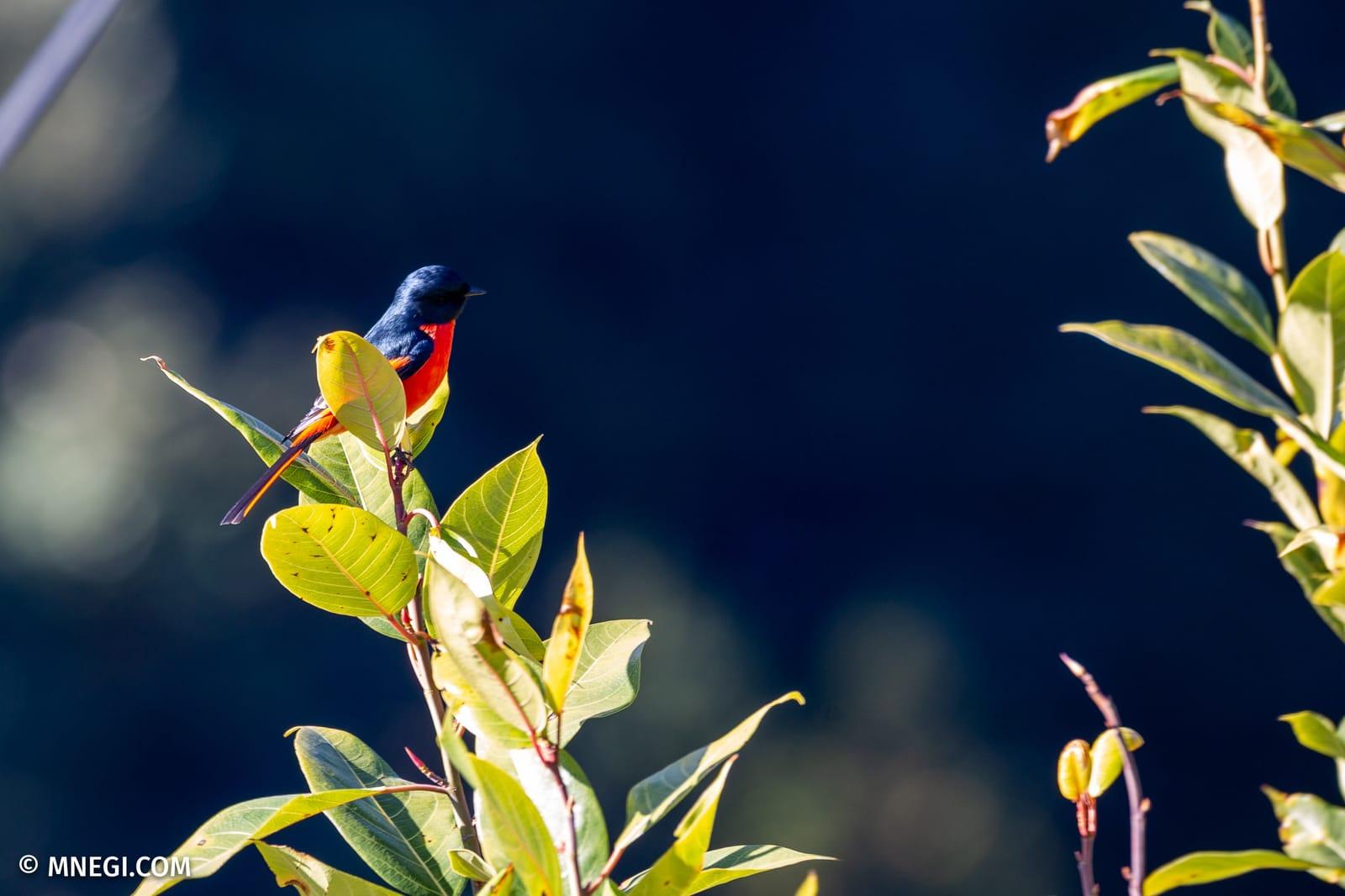
Train your eye on two places in particular. First, the bare tops of trees and the ends of exposed branches, where birds like to perch in the open to sing, to sun themselves, or to watch for insects — a minivet, a drongo, a barbet will often sit up high and obvious. Second, the low, dense tangle of the undergrowth and the hedge bottoms, where the shyer birds — the wren-warblers, the babblers, the skulking thrushes — feed close to the ground, mostly unseen. Most beginners watch only the middle of a tree, and miss both.
Read the bird, not just the colour
When a bird does appear, the instinct is to fix on its colour and start flipping through a book. Try to resist it — colour is the least reliable thing about a bird, changing with the light, the season, and the angle. Far better to read, in order: how big is it, taking a sparrow, a myna, and a pigeon as your rough yardsticks? What shape — slim and long-tailed, or round and stubby? And, above all, what is it doing — creeping up a trunk, hawking insects from a perch, hopping on the ground, hanging upside down in the leaves?
This combination of size, shape, and behaviour — birders call it a bird's 'jizz' — will get you to the right family far quicker than colour ever will. And a great deal of the quiet pleasure of birding lies in reading a bird this way, getting to know it, before you ever reach for its name.
Dress quiet, move quiet
You don't need camouflage, but you do need to dress down: muted greens, browns and greys, nothing bright, nothing white, and nothing that rustles or flaps as you move. Keep your voice low — a normal speaking voice carries a surprising distance in still hill air — and put your phone on silent. Birds notice everything, and the quieter and duller and slower you are, the closer they will let you come.
The single most useful habit is to avoid sudden movement. Raise your binoculars slowly. Turn your head, not your whole body. If a bird is close and you don't want to lose it, freeze rather than reach. It is astonishing how close a calm, still, unremarkable person can get to a wild bird.
A little kit goes a long way
You can do all of the above with nothing but your eyes and ears. But one piece of kit changes everything: a pair of binoculars. They needn't be expensive — any decent 8x42 pair will do, and 8x is the sweet spot for hill birding, bright enough for shaded forest and steady enough to hold without a wobble. The trick most people get wrong is to hunt for the bird through the binoculars; instead, find it with your naked eye, lock your gaze onto it, and bring the binoculars up to your eyes without looking away. With a little practice it becomes second nature.
Two cheap additions earn their place many times over. A 'birds of the Himalaya' app on your phone, with its photographs and — crucially — its calls, will teach you faster than any book and weighs nothing. And a small notebook: jot down what you saw, where, and when. It feels fussy at first, but writing things down is exactly how casual looking turns, over a season, into real knowing.
Start with the birds at your feet
There's a temptation, when you start, to go chasing the rare and the spectacular. Don't — not yet. The fastest way to get good is to learn the common birds cold: the house sparrows in the eaves, the mynas strutting in the yard, the bulbuls in the hedge, the treepies and the great barbet in the oaks. These are the birds you'll see every single day, and once you know them by sight, sound, and habit, they become your reference. Every new bird is then learned by how it differs from one you already know — 'like a bulbul, but…' — and that, one familiar bird at a time, is how a birder's eye is built.
Learn the seasons
Finally, learn the rhythm of the year, because many of the best birds are visitors. In winter, birds that summer high in the Himalaya — redstarts, rosefinches, thrushes, accentors — come down to the warmer middle slopes around Kunja to escape the snow. In summer and the monsoon, the breeding visitors arrive from below: the Indian paradise flycatcher trailing its long white ribbons, the cuckoos calling unseen, the flycatchers busy with nests and young. Spring is the loudest season, autumn the clearest. Knowing roughly what to expect when means you head out looking for something in particular — which is always more rewarding, and more successful, than heading out simply hoping.
A morning, start to finish
If it helps to picture it: you are on the terrace a few minutes before sunrise, tea in hand, doing nothing but listening. The first voices are the bulbuls and the sparrows close by; then, as the light grows, the great barbet starts up somewhere across the valley, and a treepie scolds from the oaks. You don't move. A party of laughingthrushes works noisily along the hedge below; a verditer flycatcher, impossibly blue, lands on the wire and sallies out after insects. You lift the binoculars slowly, watch it a while, and let it go.
Half an hour passes like five minutes. By the time the sun is properly up and the chorus begins to thin, you have seen a dozen or fifteen species without taking more than a few steps from where you started — which is rather the whole point. The birds were always going to be there. All you did was arrive early, keep still, and pay attention.
Alone, or in good company
Birding rewards both. Alone, you move at your own pace and the quiet is entirely yours; you will often see more, simply because one still person disturbs less than two talking ones. But a sharper-eyed companion will find birds you'd have walked past and put names to the ones that puzzle you, and there is a real pleasure in sharing a good sighting. If you are new to it, a single morning beside someone who already knows the local birds is worth a dozen alone — and at Kunja, that companion is usually only a request away.
“Go out looking for something. It is always more rewarding than going out hoping.”
So that is the whole of it: go early, listen first, move slow, watch the edges, dress quiet, learn the common birds, and follow the seasons. Not one of these habits costs anything but a little patience. Try them on the next clear morning — ideally from a terrace in the hills, with a mug of tea going cold at your elbow — and see just how full an ordinary morning can be.
What it gives back
Spend a few mornings like this and something shifts. You stop seeing 'a bird' and start seeing a barbet, a minivet, a redstart — each with its own habits and its own place in the day. The hillside, which had looked like scenery, turns out to be busy with lives, and you find you can read it. That, far more than any single rare sighting, is the real reward: not a longer list, but a place you can no longer walk through without noticing who else lives there.
About the author
Manohar Negi
Owner & host
Manohar grew up in these hills and never really left. A photographer by craft and a host by heart, he turned the family home at Kunja into a place to share — and most of the frames you see across this site are his.
More about Manohar
Keep reading
Related pieces
 Birding
Photographing the birds of the hills: a quick start
A long lens helps, but patience and respect matter more. A beginner's guide to making honest photographs of the wild birds of the Kumaon hills.
Read it Birding
The birding year in Kumaon, month by month
Which birds are around when — from the spring nesting rush to the winter visitors down from the high Himalaya. A seasonal guide to birding around Kunja.
Read itBirdingThe gear we use for bird photography
Guests often ask what's in the bag. The honest answer: not much, and nothing new. Here's exactly what we carry up the hill, and what each piece is for.
Read it
Comments(3)
Ananya R.May 2026
Exactly what I needed before our trip — the bit about listening first completely changed how I walk. Saw a great barbet on day one!
Vikram S.Apr 2026
Lovely, practical piece. Would love a follow-up on the best binoculars for a beginner.
Meera J.Apr 2026
We stayed in March and the dawn chorus alone was worth the trip. The terrace really is the best seat in the house.